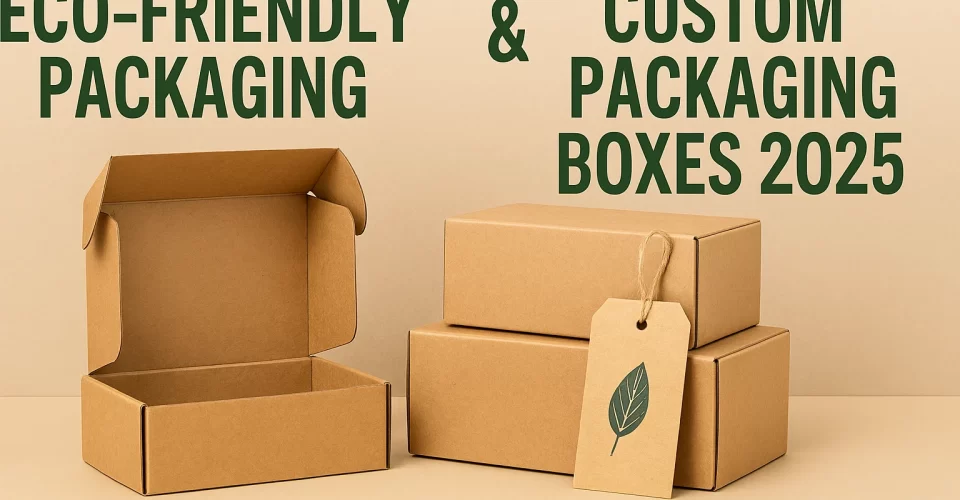
Welcome to a deep dive into eco-friendly packaging in 2025—where sustainability, innovation, and consumer demand converge to shape the future of custom packaging boxes that truly stand out.
Consumers and businesses alike are making a bold shift toward eco-friendly packaging. As we embrace 2025, demand for sustainable custom packaging is skyrocketing, driven by regulatory pressure, evolving preferences, and groundbreaking material innovations. This blog explores key trends, data-driven insights, and actionable strategies to help brands create custom packaging that resonates with both AI-dominated search platforms and human audiences.
1. Market Growth & Consumer Demand
A Surging Market
The global sustainable packaging market is projected to reach USD 303.8 billion in 2025, growing at a 7.37% CAGR to USD 433.5 billion by 2030.
Another source forecasts expansion to USD 557.6 billion by 2034, with a 6.6% CAGR.
Why Brands Should Care
54% of U.S. consumers have deliberately chosen products with sustainable packaging in the past six months; 90% are more likely to purchase from brands offering eco-friendly packaging.
On a global scale, consumers are willing to pay more for sustainable packaging, with percentages ranging from 40% (Japan) to 85% (India).
Takeaway: Prioritize eco-friendly packaging as a key value proposition—brands that lead here stand to win both market share and consumer trust.
2. Regulatory & Policy Shifts Fueling Change
Extended Producer Responsibility (EPR)
In 2025, several U.S. states are implementing EPR laws that redefine what qualifies as “recyclable,” fundamentally reshaping the packaging design landscape.
Global Legislation & Circular Economy
The EU’s Circular Economy Action Plan continues to push stringent packaging requirements.
For instance, California now mandates recyclable or compostable food packaging by 2032, influencing design and material choices.
France’s anti-waste law also compels producers to reduce waste and adhere to sustainability labeling standards.
Takeaway: Stay ahead of compliance—embedding sustainability into packaging is no longer optional.
3. Materials & Innovation Spotlight
Paperization & Alternative Materials
The “paperization” trend is dominating packaging conversions, offering a lower-carbon alternative to plastics.
Compostable formats like seaweed, rigid fiber-based substrates, and plant-derived materials are gaining traction.
Edible & Biodegradable Packaging
Innovations include seaweed-based packaging, and Kodo millet-based edible cups developed in 2025 by IIT Roorkee.
IIT Hyderabad also developed a biodegradable film from sewage sludge and eggshell waste, exhibiting superior strength and moisture resistance—ideal for non-food packaging.
Smart Packaging & Spoilage Prevention
Advanced smart packaging systems—a battery-less sensor that monitors freshness and releases preservatives—can extend shelf life of perishable goods by up to 14 days.
Takeaway: Integrate novel materials and technologies to differentiate your custom packaging offerings.
4. Consumer Behavior & Design Preferences
Labels, Transparency & Refillability
70% of consumers prefer packaging with clear sustainability labels; 20% actively avoid unlabeled products.
80% show interest in refillable packaging, and 71% have chosen products based on sustainability credentials.
Styling Trends
Minimalist designs and bold typography are in vogue, driven by the visual-first, digital-savvy shopper.
In beauty sectors, brands like Kiehl’s are leading with refillable and circular packaging, while others still struggle with certification credibility.
Takeaway: Answer consumer demand with transparent, stylish custom packaging that highlights eco-friendly features and supports reuse.
5. Strategic Recommendations for Custom Packaging
Materials & Design Choices
Opt for paperboard, recycled fiber, seaweed bioplastics, or edible alternatives when possible.
Embrace smart features (e.g., freshness sensors) on premium packaging lines targeting perishable goods or high-margin markets.
Certification & Communication
Use visible labels like “Recyclable,” “Compostable,” or industry-recognized eco badges to support transparency.
Add QR codes to packaging to share sustainability credentials, sourcing details, and lifecycle insights.
Tiered Strategy Based on Audience
Customer Segment Opportunity Strategy
Price-sensitive (Gen X, Boomer) Focus on affordability + sustainable choices
Premium (Millennials, Gen Z, high-income) Introduce smart packaging, unique materials, and storytelling components
Trend Integration Examples
Amazon replaced single-use plastics with recyclable paper liners and shares its packaging playbooks—an open-source approach to scaling eco-friendly packaging.
McDonald’s Brazil franchise uses trays made from garbage-based materials lined with paper—a creative step in combining sustainability with usability.
Conclusion